


Table of Contents
- What Causes Large Pores (and What You Can Actually Change)
- Step 1: Cleanse Twice Daily to Keep Pores Clear
- Step 2: Build a Skincare Routine for Large Pores That Fits Your Skin Type
- Step 3: Use Salicylic Acid for Pores Without Over-Exfoliating
- Step 4: Add Retinol and Niacinamide to Support Cell Turnover
- Step 5: Protect Your Skin Barrier and Use Sunscreen Daily
- How Long Does It Take to See Results from a Pore-Care Routine?
- Common Mistakes That Make Pores Look More Noticeable
- Frequently Asked Questions
Last Updated: October 17, 2026
What Causes Large Pores (and What You Can Actually Change)
Pore size is mostly genetic, but oil flow and collagen loss make pores look bigger over time. You can't shrink a pore permanently, but you can minimize large pores by keeping them clear, calm, and less visible.
At rizzi by M, we build routines around that reality. No promises of permanent shrinkage. Just steps that make pores look smaller in photos and in the mirror.
Genetics, oil, and collagen loss
Three forces drive how visible your pores look:
- Genetics set your baseline pore size. You inherit it, and it doesn't change.
- Excess oil flows through the pore and stretches the opening over time.
- Collagen loss weakens the skin around each pore, so the edges look slack and the opening reads larger.
Sun exposure and age speed up collagen loss, which is why pores look more obvious in your 30s and 40s than at 20.
The one thing you cannot do: shrink them permanently
No cleanser, serum, or mask shrinks a pore for good. Pores have no muscle and can't open and close on command.
What you can do is minimize large pores in appearance. Clear out what's sitting inside, calm the skin around the rim, and support collagen. The opening stays the same size. It just stops looking so obvious.
Step 1: Cleanse Twice Daily to Keep Pores Clear
Cleansing twice daily keeps oil and dead skin cells from collecting inside the pore, buildup that casts a shadow and makes pores look dark and wide.
Our Radiant Glow Facial Wash is built for this step: it dissolves impurities, excess sebum, and makeup buildup without clogging pores, and suits normal and oily skin.

One warning: don't over-cleanse. Washing more than twice a day, or scrubbing hard, irritates the barrier and makes oil worse.
Step 2: Build a Skincare Routine for Large Pores That Fits Your Skin Type
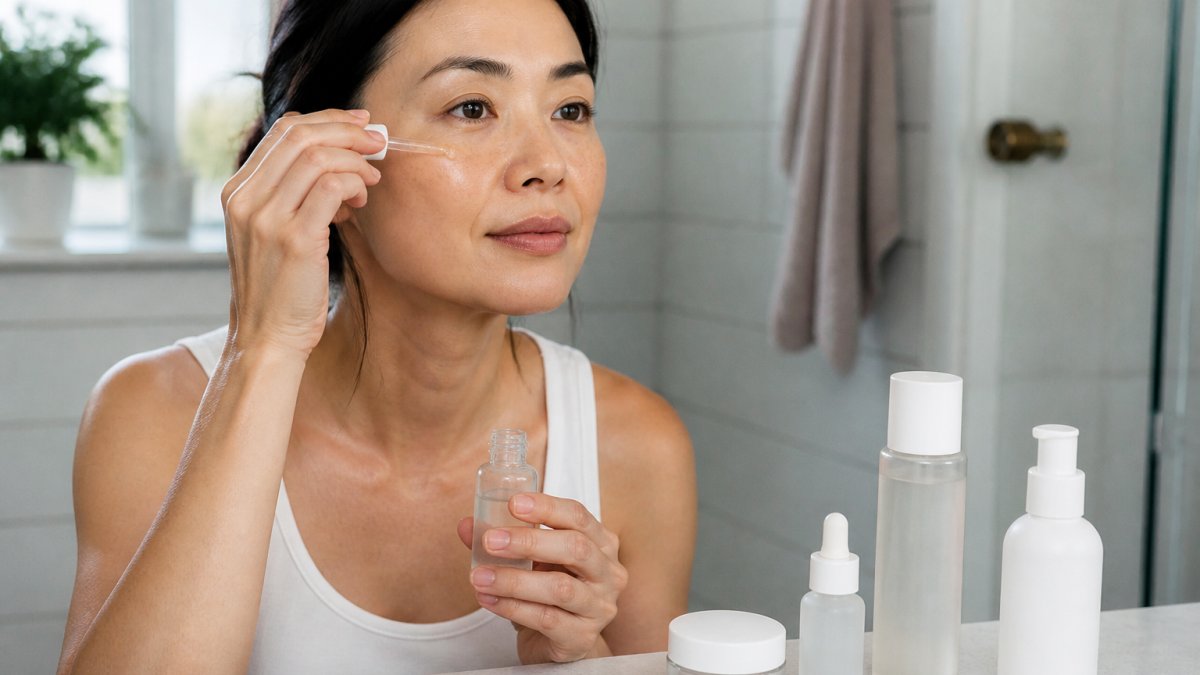
A skincare routine for large pores works only if it matches your skin type. The same acids that clear oily skin will wreck sensitive skin. Start with your skin type, not the trend.
Oily and combination skin
Oily skin tolerates more active ingredients. A workable order:
- Gentle cleanser, morning and night
- Salicylic acid a few nights a week
- Lightweight moisturizer, even if you're oily
- Sunscreen every morning
Skip heavy creams. They sit on the skin and can trap oil in the pore.
Sensitive or reactive skin
Sensitive skin needs fewer products, introduced slowly: a fragrance-free cleanser, one active once a week, a barrier-supporting moisturizer, and mineral sunscreen. Add one product at a time and give each two weeks.
| Skin Type | Cleanser | Active | Moisturizer | Frequency |
|---|---|---|---|---|
| Oily | Gel cleanser | Salicylic acid | Light gel | Acid 2-3x weekly |
| Combination | Gel or cream | Niacinamide | Lotion | Daily |
| Sensitive | Fragrance-free cream | One gentle active | Barrier cream | Active 1x weekly |
| Dry | Cream cleanser | Lactic acid | Rich cream | Acid 1x weekly |
Step 3: Use Salicylic Acid for Pores Without Over-Exfoliating
Salicylic acid for pores is the best-studied over-the-counter option. It's oil-soluble, so it gets inside the pore and breaks down the oil and dead skin cells that clog it. Use a leave-on 2% formula two or three nights a week, not with a scrub or other acids the same night.
Signs you're over-exfoliating:
- Stinging when you apply products
- Flaking or tightness
- Redness that lasts more than an hour
If any of those show up, stop the acid for a week. Then restart once a week.
Step 4: Add Retinol and Niacinamide to Support Cell Turnover
Retinol and niacinamide have the clearest pore-appearance case among over-the-counter ingredients, but they work through different mechanisms and are not interchangeable. Knowing what each does, and cannot do, keeps you from layering actives that fight each other.
How each ingredient actually works
- Retinol (a retinoid) speeds up keratinocyte turnover so dead cells shed before they pile up in the pore, and it supports dermal collagen over time, firming the skin around each pore. That collagen effect is slow, months, not weeks, and it is the only over-the-counter lever for the structural side of pore appearance.
- Niacinamide (vitamin B3) boosts ceramide production, helps regulate sebum, and modestly calms redness. It does not exfoliate or build collagen; it makes the pore environment less reactive so oil flow stays steady.
- Salicylic acid (Step 3) is the oil-soluble exfoliant that clears the clog itself. Retinol and niacinamide support the surrounding skin; salicylic acid empties the pore. They are complementary, not redundant.
A common pattern: salicylic acid two or three nights a week, retinol on the other nights, and niacinamide every morning. That rotation keeps each active doing its own job without stacking irritation.
Retinol: strength, frequency, and the sandwich method
Start with an over-the-counter retinol, not a prescription retinoid, unless a clinician recommends otherwise, it's weaker and converts to retinoic acid gradually, giving your barrier time to adapt.
Clay Mask for Pores and Blackheads →
A workable introduction:
- Week 1-2: Apply a pea-sized amount twice a week at night, after moisturizer (the "sandwich" method, moisturizer, retinol, moisturizer).
- Week 3-4: If there is no stinging, flaking, or redness lasting more than an hour, move to three nights a week.
- Week 5-8: Add a fourth night if tolerated. Most people plateau at three to four nights a week and do not need more.
- Month 3 onward: Maintain the frequency that keeps skin calm. More frequent use does not speed results; it only raises irritation risk.
Signs you moved too fast: stinging on application, flaking around the nose and mouth, tightness, or lingering redness. If those appear, drop back to twice a week for two weeks before advancing.
Niacinamide: concentration and pairing
Niacinamide is gentler and can be used daily, morning or night. Most well-formulated products sit in the 2-10% range; higher concentrations aren't automatically better and can sting sensitive skin.
Our Exosome & Niacinamide Serum pairs niacinamide with lactic acid and hyaluronic acid, so it refines texture while keeping skin hydrated. It suits all skin types and layers easily morning or night.

Ingredient comparison at a glance
| Ingredient | Primary pore benefit | Mechanism | Best for | Typical use | Main caveat |
|---|---|---|---|---|---|
| Salicylic acid | Clears clogs inside the pore | Oil-soluble exfoliant; dissolves sebum and dead cells | Oily, combination, acne-prone | Leave-on 2% formula, 2-3 nights weekly | Overuse irritates the barrier |
| Retinol | Improves texture and supports collagen | Speeds cell turnover; supports dermal collagen | Most skin types, introduced slowly | 2-4 nights weekly, built up over months | Purging and irritation if rushed |
| Niacinamide | Calms and balances | Supports barrier ceramides; helps regulate sebum | All skin types, including sensitive | Daily, morning or night | High concentrations can sting |
| Glycolic acid | Surface texture refinement | Water-soluble AHA; loosens surface dead cells | Non-sensitive skin with dull texture | 1-2 nights weekly | Photosensitivity; not for reactive skin |
| Lactic acid | Gentler texture refinement | Larger-molecule AHA; surface exfoliation with more hydration | Dry or sensitive skin | 1 night weekly to start | Still an acid; introduce slowly |
What not to combine
- Retinol plus a strong acid on the same night. Pick one per evening. Alternate nights instead.
- Two new actives in the same week. You cannot tell which one is causing irritation, and you cannot isolate what is working.
- Retinol plus a physical scrub. The scrub abrades skin that retinol has already made more permeable.
Step 5: Protect Your Skin Barrier and Use Sunscreen Daily
Sun protection is the most underrated pore step. UV exposure breaks down collagen, and lost collagen is what makes pores look slack and open.
Our SPF30 Tinted Sunscreen is mineral-based and dermatologically tested. It evens out skin tone for a naturally radiant look without a white cast, and it's enriched with hyaluronic acid and sea buckthorn to keep skin comfortable.
Barrier care matters too. A moisturizer with ceramides or glycerin keeps the skin calm. A calm barrier produces less reactive oil.
How Long Does It Take to See Results from a Pore-Care Routine?
Pore care is slow, and the timeline depends on which change you're waiting for: clearing a clog is fast, rebuilding collagen is slow. Most disappointment comes from expecting the second kind of result on the first kind of timeline.
Two different clocks
- Appearance clock (days to weeks). Clearing oil and dead cells, calming redness, and reducing midday shine can change how pores look within two to six weeks. It is real but reversible, stop cleansing and exfoliating and the clog returns.
- Structure clock (months). Collagen support from retinoids and daily sun protection firms the skin around the pore. It is the only change that makes pores look smaller in a way that holds, takes three to four months of consistent use, and is modest, pores do not disappear, they become less obvious.
A stage-by-stage expectation
| Stage | What is changing | What you may notice | What you should not expect |
|---|---|---|---|
| Weeks 1-2 | Barrier adjusting to new actives | Skin feels calmer; less midday shine; possible mild purging if starting an acid or retinol | Visible pore shrinkage |
| Weeks 3-6 | Clogs softening; surface cells turning over | Pores look clearer; blackheads soften; makeup sits more smoothly | Permanent change |
| Months 2-3 | Collagen support beginning; texture smoothing | Tone looks more even; texture feels smoother to the touch | Dramatic pore-size change |
| Months 3-4 | Collagen effect accumulating | Pore appearance noticeably reduced in consistent lighting | Pores closing or disappearing |
How to measure progress without fooling yourself
Memory is unreliable for slow change. A simple tracking method:
- Same light, angle, and time of day. Take one photo a week in indirect daylight, facing a window, no makeup.
- Pick two or three reference pores near the nose or inner cheek and compare those, not the whole face.
- Note the variables. Record which actives you used and how many nights; if you changed three things, you cannot attribute the result.
- Review monthly, not daily. Weekly photos are for the record; judge every four weeks.
What "working" actually looks like
A routine is working if, over four to eight weeks, you see any of the following:
- Less midday shine on the T-zone
- Softer blackheads that extract more easily or fade on their own
- Less redness around the nose and inner cheeks
A routine is not working if breakouts worsen week over week, stinging persists, or redness lasts more than an hour after application. Those are signs to reduce frequency, not add products.
Anyone promising visible pore shrinkage in days is selling a temporary effect, a primer, clay mask, or cold rinse that plumps skin for a few hours. Fine as cosmetic tools, but the routine is the four months.

Common Mistakes That Make Pores Look More Noticeable
Most pore routines fail for predictable reasons:
- Picking and squeezing. This damages the pore wall and can leave a permanent scar that looks like a bigger pore.
- Using pore strips. They pull out the top of the clog and leave the rest. The pore looks the same within days.
- Over-washing. More than twice daily strips the barrier and triggers more oil.
A clay mask once or twice a week can help between steps. Our Clay Mask for Pores and Blackheads uses white and green clays to absorb excess oil, with algae and a biomineral complex to support balance. Leave it on for 5 to 10 minutes, then rinse.
Pore care rewards patience more than products. For a routine built on clean ingredients and no unnecessary steps, rizzi by M offers a focused lineup: our Radiant Glow Facial Wash for daily cleansing, our Exosome & Niacinamide Serum for texture and barrier support, and our SPF30 Tinted Sunscreen for daily protection.
Frequently Asked Questions
Can you actually shrink large pores?
No, you cannot permanently shrink large pores. Pore size is largely determined by genetics and oil production, and pores do not have muscles to tighten. What you can do is minimize their appearance by keeping them clear of excess oil and dead skin cells, supporting collagen with retinoids, and protecting skin from sun damage. A consistent skincare routine for large pores can make them look smaller, but the goal is reducing visible pore appearance, not changing your pore structure.
Does salicylic acid help minimize large pores?
Yes, salicylic acid for pores is one of the most effective over-the-counter options. It is oil-soluble, so it penetrates the pore lining and helps dissolve the mix of sebum and dead skin cells that makes pores look enlarged. Use a 2% salicylic acid cleanser or toner two to three times per week to start, and increase only if your skin tolerates it. Overuse can irritate the skin barrier, which makes pores look more noticeable, so introduce it slowly.
How long does it take to see results from a pore-care routine?
Most people notice a smoother texture and less visible pore congestion within four to six weeks of consistent cleansing, exfoliation, and hydration. Retinol and collagen-supporting ingredients take longer, often 12 weeks or more, because they work by supporting skin renewal. Take photos in the same lighting every two weeks to track subtle changes. If you see no improvement after three months of a consistent routine, consider seeing a dermatologist for prescription options or professional treatments.
What skincare habits can make pores look more noticeable?
Skipping sunscreen, over-washing, and using too many harsh actives at once are common culprits. Sun damage breaks down collagen, which weakens the skin around pores and makes them look larger. Over-cleansing or over-exfoliating irritates the skin barrier, triggering more oil production and inflammation. Picking at blackheads and using pore strips can also enlarge the look of pores over time. Stick to gentle cleansing twice daily, one exfoliant, and daily SPF to keep pores looking their smallest.