


Quick Summary
To simplify skincare routine for travel, pack only a cleanser, a moisturizer, and sunscreen, adding one treatment only if your skin needs it. Decant products into small, labeled, sealed containers and check current TSA liquids rules before you fly.
- Cabin air is very dry, so moisturize before boarding and again mid-flight.
- Pack a cleanser, moisturizer, and SPF 30 or higher sunscreen as your core routine.
- Fill decanting containers to about 90 percent to leave headspace for pressure changes.
- Seal bottle caps with plastic wrap or tape and double-bag liquids to contain leaks.
- Match your moisturizer weight and sunscreen amount to your destination's climate.
Table of Contents
- Why a Travel Skincare Routine Needs Fewer Steps
- Step 1: Decide Your Core Routine Before You Pack
- Step 2: Choose Travel Containers and Pack the Essentials
- Step 3: Pack Skincare in Checked Luggage Safely
- Step 4: Build Your In-Flight Skincare Routine
- Adapting the Routine for Sensitive Skin and Changing Climates
- Booking Your Next Trip With a Routine You Can Keep
- Frequently Asked Questions
Why a Travel Skincare Routine Needs Fewer Steps
Travel changes your skin in predictable ways. Cabin air is very dry, and long days in sun, wind, or air conditioning can strain the skin barrier. A simplify skincare routine helps you focus on the basics that protect that barrier.
- Dry air pulls moisture from the skin during flights.
- Sun exposure increases the need for daily sunscreen.
- Irregular sleep can make skin look dull and tired.
A full home routine often includes steps that matter less on the road. You can drop them without losing much.
Step 1: Decide Your Core Routine Before You Pack
Start by listing what you use at home each morning and night. Then cut it to the essentials, because a simplify skincare routine approach works best when you only pack what you truly need. Most people need a cleanser, a moisturizer, and sunscreen. Add one treatment only if your skin needs it.
Write your routine on paper first. Seeing the list makes it easier to skip extras.
Adjust the Routine to Trip Length and Itinerary
A weekend trip needs fewer products than a three-week journey. Match your kit to how long you'll be gone and where you're headed.
- Short trips (under 4 days): Pack a cleanser, moisturizer, and sunscreen.
- Medium trips (4 to 10 days): Add a treatment serum if you use one at home.
- Long trips (over 10 days): Plan to restock or bring a multi-use product to cover more needs.
If you plan a beach stop, bring extra sunscreen. If you hike in cold, dry places, bring extra moisturizer.
Step 2: Choose Travel Containers and Pack the Essentials
Containers are where most travel routines fail. A good kit is small, sealed, and labeled so you can find things in a dim hotel bathroom at midnight. Start with the rule that governs everything else: check the current liquids rules of the Transportation Security Administration (TSA) before you fly, because enforcement details and screening technology change.
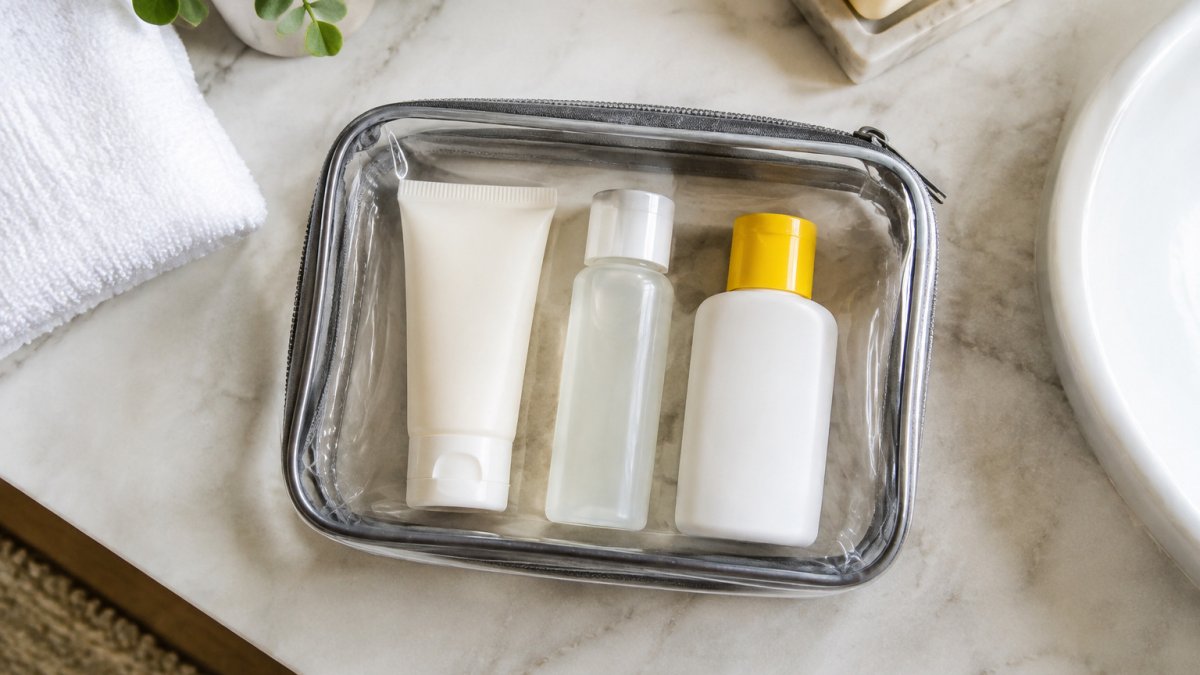
That single rule should drive your product choices. If a product only comes in a 6-ounce bottle, either decant it or plan to check it. Do not assume a half-full 5-ounce bottle will pass; the container size is what counts, not the amount inside.
Decanting Without Wasting Product or Losing the Label
Decanting is the difference between a compact kit and a bag of full-size bottles. A few mechanics make it work:
- Use food-grade silicone tubes or small PET bottles for cleansers and moisturizers. Silicone is squeezable, so you can get the last bit out, and it survives baggage handling better than rigid plastic.
- Leave a little headspace. Fill containers to about 90 percent so temperature changes and cabin pressure do not force product out through the cap.
- Label every container with a permanent marker or a strip of masking tape. Cleanser and moisturizer look identical in a 1-ounce tube, and mislabeling is how people end up washing their face with conditioner.
- Clean and dry containers fully before refilling.
- Do not decant prescription treatments unless the label stays with the container. A prescription in an unlabeled tube is a safety problem and can complicate screening.
A simple packing list to start from:
- Cleanser, travel size (1 to 3.4 ounces)
- Moisturizer, travel size
- Sunscreen, SPF 30 or higher (decant or buy a travel-size tube) (the American Academy of Dermatology)
- One treatment product, if needed
- Make-up remover, fragrance free
For a fragrance-free option, the BiPhasic Make-up Remover, Fragrance Free is a good fit for a compact kit.

Carry-On Liquid Rules and Leak-Proof Packing
The quart bag is not just a screening requirement; it is also your leak containment system. Pack it deliberately:
- Seal each cap with a small piece of plastic wrap or a strip of electrical tape before closing the bottle. This is the single most effective leak guard for thin, watery products like toners and micellar waters.
- Put every bottle in its own zip-top bag, then put those bags inside the quart bag. Double-bagging means a failure in one container does not coat everything else.
- Pack bottles upright and away from electronics. A laptop charger that presses against a cap in a crowded bag is a common cause of spills.
- Carry the quart bag at the top of your personal item so you can pull it out at screening without unpacking the whole bag.
Keep the quart bag easy to reach and do not overfill it to the point where it will not seal.
The packing list below summarises the travel-size items the article recommends for a compact skincare kit.
| Item | Size or spec | Note |
|---|---|---|
| Cleanser | 1 to 3.4 ounces | Travel size |
| Moisturizer | Travel size | Pack for the climate |
| Sunscreen | SPF 30 or higher | Decant or buy travel tube |
| Treatment product | As needed | Only if your skin needs it |
| Make-up remover | Fragrance free | Compact kit option |
| Decanting container fill | About 90 percent | Leaves headspace for pressure |
Step 3: Pack Skincare in Checked Luggage Safely
Liquids above the carry-on limit must go in checked bags. Wrap each bottle in a sock or small towel. Place them in the center of your suitcase, surrounded by soft clothing.
Pack the Sensitive Skin Face & Body Cleanser in a sealed bag inside your checked luggage. It is suitable for both the face and body.

Check your bag once you arrive. A small leak is easier to fix early.
Step 4: Build Your In-Flight Skincare Routine
Long flights dry out the skin fast. A simple routine during the flight helps.
- Drink water before and during the flight.
- Apply moisturizer before you board.
- Use a light mist or a thin layer of moisturizer on your face mid-flight.
- Apply sunscreen before you land if you'll be outside.
Keep these items in your personal bag so they're easy to reach.
Adapting the Routine for Sensitive Skin and Changing Climates
Most travel skincare advice stops at "adjust for the climate." The useful version is a decision rule: match your moisturizer weight, cleanser strength, and sunscreen habits to the destination before you pack, not after you arrive.
A Destination-Based Decision Guide
Use the climate you are traveling to as the first filter, then adjust for trip length and itinerary.
- Hot and humid (coastal, tropical, summer city trips): Switch to a lighter gel or lotion moisturizer and a gentle, low-foam cleanser. Humidity reduces water loss from the skin, so a rich cream can feel occlusive and contribute to breakouts. Keep sunscreen lightweight and reapply every two hours outdoors; sweat and humidity break down film-forming sunscreens faster than dry air does.
- Cold and dry (winter, high altitude, desert): Move to a richer cream or an ointment-based moisturizer, and consider a hydrating layer under it. Cold air holds little moisture, and indoor heating lowers humidity further.
- Sun-heavy destinations (beach, ski, high altitude): Treat sunscreen as the primary product, not an add-on. UV intensity rises with altitude, and snow and water reflect UV back onto the skin. Plan to reapply sunscreen, which may mean bringing a second travel-size tube or buying locally.
- Air-conditioned or heavily heated environments (conference hotels, long transit days): The indoor air can be as drying as the outdoors. A thin layer of moisturizer mid-day and drinking water regularly matter more than adding new products.
A common pattern is that people over-pack for the climate they left and under-pack for the one they are entering. Check the forecast for your destination the week before you leave and adjust the moisturizer weight and sunscreen quantity accordingly.
Sensitive Skin and Prescription Treatments
Sensitive skin reacts more to new products and new conditions. Keep your routine as close to your home routine as you can, and avoid trying new products right before a big trip.
If you use a prescription treatment, such as a retinoid or a medicated acne product, plan for it explicitly:
- Do not start or stop a prescription right before travel. A flare from a new treatment is harder to manage away from home.
If you're choosing a new moisturizer for sensitive skin, read this guide on how to choose a moisturizer for sensitive skin. It explains what to look for in a formula.
If your skin reacts, simplify back to cleanser, moisturizer, and sunscreen before adding anything new.
Booking Your Next Trip With a Routine You Can Keep
A simple routine works best when you can keep it going. Practice your travel routine at home for a week before you leave. That way, you'll know what works.
If you want to keep a minimal routine long term, see this minimalist skincare routine guide for more ideas.
Plan your next trip with a kit that fits your skin and your schedule. A short list, a few good products, and a clear plan will keep your skin comfortable from takeoff to landing.
Frequently Asked Questions
What is the best skin care routine to follow while traveling?
A short routine works best: cleanse, hydrate, moisturize, and apply sunscreen by day. Use a gentle cleanser such as the Sensitive Skin Face & Body Cleanser ($20.99), which is dermatologically tested and suitable for all skin types. Add a lightweight moisturizer for dry cabin air, and keep the routine the same from home so your skin stays predictable. Skip any active you do not truly need on the road, and reintroduce treatments once you are home and settled.
How can I simplify my skincare routine for a trip?
Start by cutting every product that is not a cleanser, moisturizer, or sunscreen, then add back only what your skin needs. Match the number of products to the trip length: a weekend needs fewer items than two weeks. Choose multipurpose products where possible. The BiPhasic Make-up Remover, Fragrance Free ($18.99) is a fragrance-free option for removing makeup.
How do I pack skincare in checked luggage?
Pack liquids in sealed, leak-proof travel containers and place each one inside a zip-top bag. Wrap bottles in a clean layer of clothing and keep them away from electronics and shoes. Transfer products to smaller containers where possible so that a single leak does not ruin your clothes. Check that the caps are tightened and that pumps are locked before you close the suitcase.
What skincare should I use on an international flight?
Keep the in-flight routine simple: a gentle cleanse with a facial wash such as the Radiant Glow Facial Wash ($22.99), a hydrating moisturizer, and a layer of sunscreen if you will be near a window. Apply a moisturizer before boarding and reapply during the flight. Drink water and avoid heavy makeup, which can feel uncomfortable in dry conditions.
