


Last Updated: November 17, 2026
Quick Summary
Expensive skincare is sometimes better, but not in the way the price tag suggests. A higher price can buy better ingredients, more stable formulas and smarter packaging, but it can also buy heavy glass jars and marketing. The only fair comparison is cost per use, not the sticker price.
- Divide price by the number of applications in the container to get a fair cost per use.
- The ingredient and formulation share of a price is often the smallest slice.
- Spend on serums with proven actives, daily sunscreen and a tolerated moisturizer.
- Cleansers, micellar water and basic toners are fine to buy cheap.
- A luxury cream that sits half-used on the shelf has an infinite cost per use.
Table of Contents
- What the Price Tag Actually Tells You About Expensive Skincare
- Affordable vs. Luxury Skincare: Where the Formulas Really Diverge
- Why Is Skincare So Expensive? Following the Money
- Ingredient Quality and Concentration: Does Paying More Buy a Better Formula?
- What Skincare Is Worth Spending Money On (and What to Buy Cheap)
- Are Expensive Face Creams Worth It? A Cost-Per-Use Reality Check
- Build a Minimal Routine That Earns Its Price
- Frequently Asked Questions
What the Price Tag Actually Tells You About Expensive Skincare
Is expensive skincare actually better? The short answer is: sometimes, but not in the way the price tag suggests. A higher price can buy better ingredients, more stable formulas, and smarter packaging. It can also buy a heavy glass jar, a celebrity face on the box, and a marketing budget. The trick is telling those apart before you pay.
Here is what the price actually reflects.
A cost-per-use lens is the only fair way to compare a $12 cream with a $120 one. Divide the price by the number of applications in the container. That number, not the sticker, tells you what you are really spending.
Below, we break down where expensive and affordable formulas genuinely diverge, which products deserve your money, and which ones you can buy cheap without regret.
Affordable vs. Luxury Skincare: Where the Formulas Really Diverge
The biggest gap between affordable and luxury skincare is rarely the hero ingredient. It is everything around it: the delivery system, the preservation, the texture, and the testing.
A drugstore moisturizer and a luxury cream can both list hyaluronic acid. What differs is the molecular weight blend, how well the formula holds up over months, and whether the texture makes you actually use it every day.
| Category | Affordable Skincare | Luxury Skincare |
|---|---|---|
| Hero ingredients | Common actives, often single-weight | Blended actives, multiple molecular weights |
| Delivery and texture | Functional, sometimes heavy or tacky | Refined, cosmetically elegant |
| Packaging | Basic tubes and jars | Airless pumps, opaque glass |
| Testing | Basic safety testing | Often broader stability and tolerance testing |
| Cost per use | Low | High, sometimes very high |
What most guides miss is that the first three rows rarely change your results on their own. For the deeper argument on why cleaner ingredient lists can matter more than price, see why clean skincare is better. The formula's stability and how faithfully you use it matter more.
Why Is Skincare So Expensive? Following the Money
Skincare is expensive because the price covers far more than the liquid inside the bottle. Packaging, marketing, brand positioning, retail margins, and research all sit in that number.
A heavy glass jar with a metal lid costs more to make and ship than a simple airless pump. A national ad campaign costs more than a dermatologist's waiting room sample. None of that improves the formula.
Here is where your money typically goes:
- Ingredients and formulation: the part that touches your skin
- Packaging: glass, pumps, and secondary cartons
- Marketing and brand positioning: ads, influencers, and retail placement
- Distribution: shelf space, shipping, and returns
- Testing and compliance: safety and stability checks
The ingredient and formulation share is often the smallest slice. That is the uncomfortable truth behind a high price point.
Ingredient Quality and Concentration: Does Paying More Buy a Better Formula?
Paying more can buy a better formula, but only when the extra money goes into concentration, stability, and evidence, not the label. Two products can list the same active at wildly different strengths, and a third can list it at a strong percentage in a package that destroys it before you finish the bottle. The only fair test is a like-for-like comparison: same active, same claimed concentration, same use case, then compare price per use and the evidence behind each claim.
Start with concentration, not the ingredient list. Ingredient concentration is the percentage of an active in the finished formula. A serum with 2% of a peptide is not the same as one with a trace amount added for the label. When a brand publishes percentages, you can judge the formula directly. When it does not, treat the claim as unverified.
Then check whether the formula can deliver the active. Concentration on the label means little if the ingredient degrades in the container. Retinol, vitamin C, and many peptides are sensitive to light and air. Packaging that limits exposure to both helps protect them, while a clear, wide-mouth jar opened twice a day exposes them to oxygen and light at every use.
Then judge the evidence, not the vocabulary. "Clinically tested" and "dermatologist reviewed" are marketing phrases unless you can see what was tested. Look for the study design (was there a control group?), the sample size, the duration, and whether the testing was independent of the brand. Small, short, brand-funded trials are common and are not proof of much.
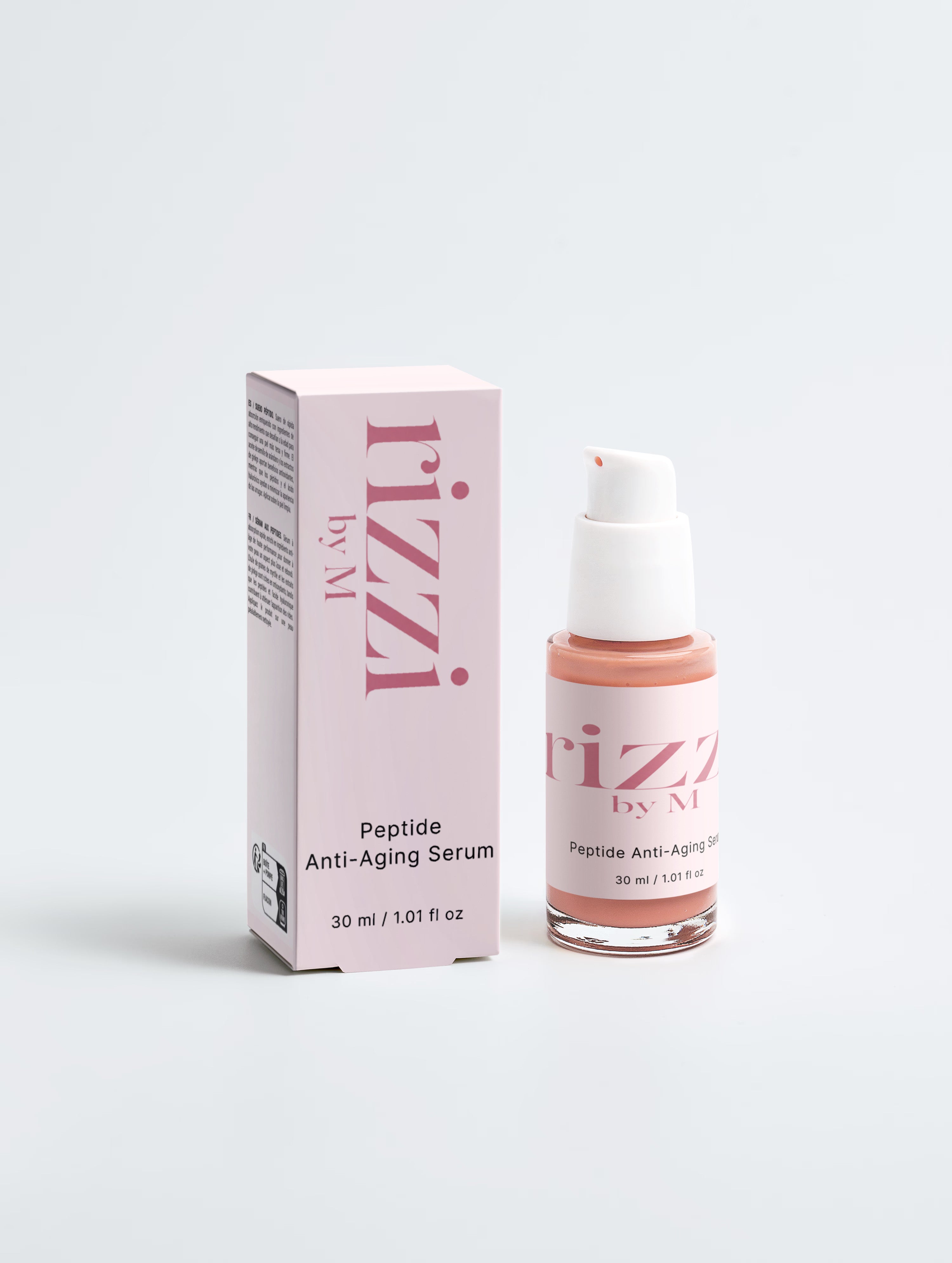
Our peptide anti-aging serum is a fair test case for this method. It lists 2% Hexapeptide-11 and 1% Ginkgo Biloba extract, so you can compare its stated concentrations against other serums on equal terms rather than guessing from the sticker. That transparency is what you should demand from any brand, luxury or not.
Watch out: a long ingredient list is not proof of quality, and a short list is not proof of potency.
What Skincare Is Worth Spending Money On (and What to Buy Cheap)
Spend on the products that stay on your skin and do the active work. Save on the ones that rinse off or mostly deliver water and slip.
Worth the investment:
- Serums with proven actives: peptides, niacinamide, and gentle retinol alternatives
- Sunscreen you will actually wear daily
- A moisturizer your skin tolerates
Fine to buy cheap:
- Cleansers: they rinse off, so fancy actives have little time to work
- Micellar water and basic toners
- Cotton pads and tools
If you are weighing a splurge on actives, our guide to gentle retinol alternatives for sensitive skin shows how to get results without paying luxury prices for irritation.
Are Expensive Face Creams Worth It? A Cost-Per-Use Reality Check
Most expensive face creams are not worth it on formula alone. They are worth it only when the texture and stability make you use them consistently, and consistency is what delivers results. The way to settle the question is arithmetic, not adjectives.
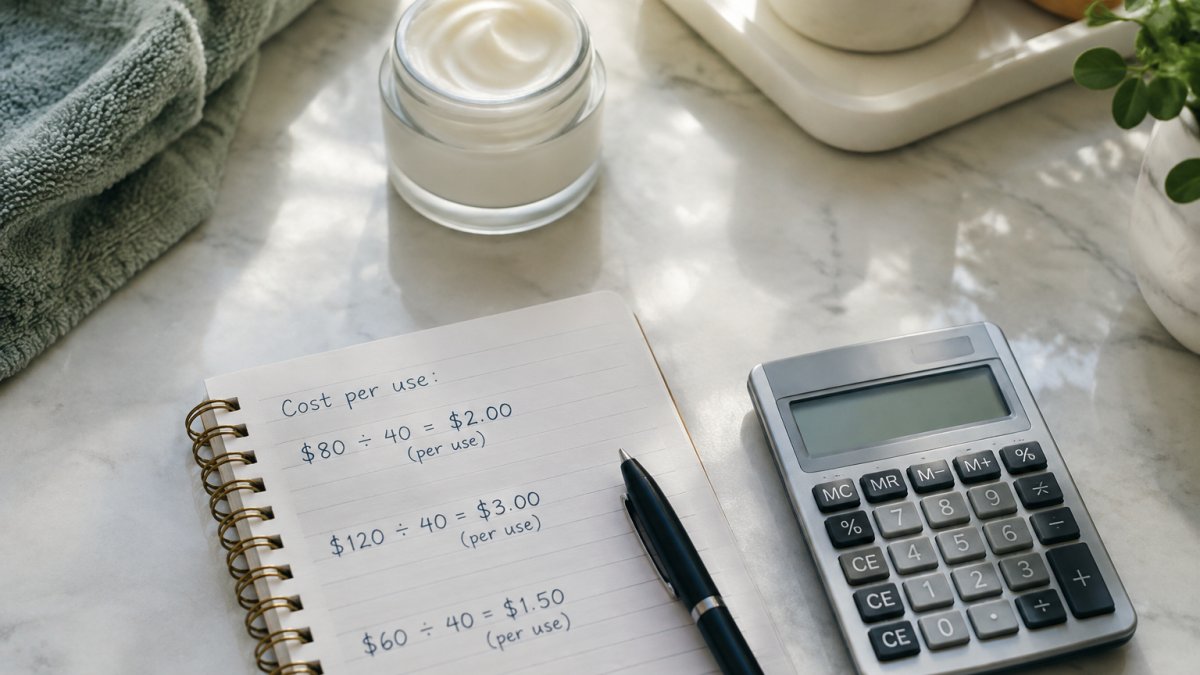
Run the cost-per-use math. Divide the price by the number of applications in the container. Applications come from package size divided by the amount you actually use per application, and that amount is larger than most people assume. Divide the price by the number of applications in the jar, where applications equal the package size divided by the amount you use each time. A $9.99 day cream costs far less per application than a $120 cream of the same size, and the gap widens further when the expensive cream comes in a smaller jar. Do this for every product in your routine and the annual total becomes visible.
Compare like with like. Cost per use only means something when the products do the same job. Compare two moisturizers at the same package size and the same recommended frequency; compare two serums at the same claimed active concentration. Otherwise you are pricing different jobs. This is the comparison most buying guides skip, and it is the one that actually answers whether the extra money buys anything.
Budget at the routine level. A routine is a monthly cost, not a shelf price. Add up cost per use across cleanser, serum, moisturizer, and sunscreen, multiply by your usage frequency, and you get a monthly figure you can compare against alternatives. A cheap product you replace every three weeks can cost more per year than a pricier one that lasts three months. Package size, recommended amount, frequency, and replacement rate all move the number more than the sticker does.
Count the cost of failure. The most expensive product is the one you cannot tolerate. Irritation, breakouts, and sensitivity lead to discontinuation, and a discontinued bottle is money spent for zero result. Factor in the possibility that a cheaper or pricier cream may simply not suit your skin, and prefer return policies and trial sizes that limit the loss. A reaction to an expensive product is the costliest outcome of all, so before you test any new cream, learn how to patch test a new face moisturizer at home.
Set a realistic timeline before you judge value. Barrier-supporting moisturizers and actives like retinoids and vitamin C often take different amounts of time before their effects are fair to assess, so give each product a defined trial period. Judging a cream after three days tells you nothing about its value. Give each product a defined trial period, note what changed, and only then decide whether the cost per use was justified.
Watch out: a luxury cream that feels beautiful but sits half-used on the shelf has an infinite cost per use, texture only counts if it keeps you applying it daily.
Build a Minimal Routine That Earns Its Price
A minimal routine beats a crowded one because every product has to justify its place. Fewer steps mean fewer chances for irritation and a clearer view of what actually works.
Start with four steps: a gentle cleanser, one treatment serum, a moisturizer, and sunscreen. Add nothing until you have used that base for several weeks and can judge the results.
For a routine built around aging skin, our minimalist skincare routine for aging covers the steps to consider.
The real challenge is not finding the most expensive cream. It is building a short, honest routine where every product earns its price. That is what rizzi by M is built for: clean, high-quality ingredients with no unnecessary fluff, from a peptide serum that lists its concentrations to a velvety day cream that delivers deep hydration and soothing care. Get started with rizzi by M and build a routine where every step pulls its weight.
Frequently Asked Questions
Does expensive skincare really make a difference?
Not by price alone. What makes a difference is the formula: active ingredients at meaningful concentrations, a delivery system that keeps them stable, and a texture you will actually use every day. A $60 cream with a weak formula underperforms a $10 cream built around proven humectants and peptides. Price is a signal of marketing and packaging budgets as much as formula quality, so read the ingredient list and compare cost per use before assuming a higher price means better results.
Are expensive face creams worth it?
Sometimes, but only when the extra money buys something measurable: a stabilized active, a fragrance-free formula for sensitive skin, or a texture that keeps you consistent. Run the math first. A $70 jar used twice daily for three months costs about $0.39 per use, while a $25 jar used once a day for two months costs about $0.42. Cost per use, not shelf price, shows which product is actually the better value for your routine.
What skincare is worth spending money on?
Spend on products that stay on your skin and carry actives: serums, treatment creams, and sunscreen. Save on cleansers and rinse-off products, since they are on your face for under a minute. For anti-aging concerns like fine lines, a peptide serum such as rizzi by M's Peptide Anti-Aging Serum ($23.99) lists a defined 2% Hexapeptide-11 concentration. Put your budget where the formula has time to work.
Can affordable skincare work as well as luxury skincare?
Yes, when the affordable product uses the same functional categories: humectants like hyaluronic acid, occlusives, and proven actives. What budget formulas often skip is elegant texture, fragrance, and expensive packaging, none of which change how well a product works. Check for a short, transparent ingredient list and a formula suited to your skin type. Sensitive skin often does better with fewer ingredients, which is where minimalist lines tend to outperform heavily fragranced luxury creams.
